


What We Leave Behind
Film: What We Leave Behind (71 min)
Director: Iliana Sosa
Available on: Netflix
Release Date: March 2022
“Grandpa was a mystery to me as a kid. I didn’t know how to talk to him. He’d smoke a lot and bring me milk fudge and tamarind candy.”
These reflections, spoken by the filmmaker, Iliana Sosa, early in her documentary, What We Leave Behind, serve as a partial introduction to the filmmaker’s grandfather, Julian Moreno. The film, shot over a 7-year period, is a slowly evolving portrait of her grandfather as he lives out his last years during his ninth decade. The film moves at an unhurried pace as it gradually sketches in some details about Julian.
Julian lives in Primo de Verdad, a small town in the state of Durango, Mexico. Throughout his life, he has regularly traveled the 17-hr trip by bus from Primo de Verdad to El Paso, Texas, to visit the members of his family who immigrated to the United States. Now that he is in his 90s, he can no longer make the trip. Instead, as a departing gift to his adult children, he decides to build another house near the small house he is now living in. “Whoever wants it, it’s theirs,” he says. “And if no one wants it, they can just sell it and divvy up the profits.” We see him assisting the builders. He shovels sand; he carries lumber.
As she visually captures small pieces of her grandfather’s life, Sosa has no overtly pedantic message to convey about aging. The film is simply a beautifully rendered portrayal of her grandfather. As one watches the film evolve, it often feels like watching the painting of a very personal portrait that gradually comes into view as the filmmaker/artist works on it. The film is richly visual along with occasional dialogue that unfolds within unhurried scenes. Occasionally, Iliana asks a question from behind her camera, and Julian responds. The film does not provide any identifications for the other family members—her aunts, uncles, and cousins—as they appear in the film. Eventually, we are able to surmise who they are, but only after several scenes.
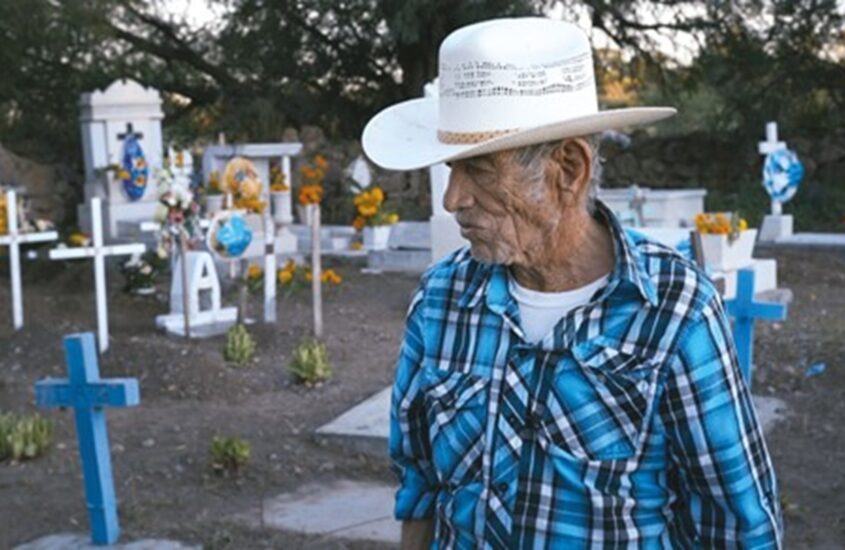
As a viewer, you will need to be in a curious and patient frame of mind to appreciate the slowly evolving magnetism of this film. The camera lingers unhurriedly on everyday scenes as they play out; this gives the viewer a chance to deeply observe both the visual and aural components of the scene. This, in turn, begins to create some anticipation for what will come next. Julian himself is very photogenic, with an attractively weathered and deeply etched face beneath the wide-brimmed hat that he usually wears (Figure 1).
Slowly, pieces of information arise organically from the meandering and roving view provided by the camera. As flowers are prepared and brought to a cemetery, for example, we learn that Julian’s wife died when she was 39 years old and that he never remarried. Some of his seven children, including the mother of Iliana, moved to the United States, and some of them stayed in Mexico. Among those who stayed in Mexico is Iliana’s uncle, Jorge, who now lives with Julian. As several scenes with Jorge play out, we come to realize that he is blind. One of Julian’s concerns, as he nears his death, is what will happen to Jorge.
Early in the film, Julian reflects on his inability to work like he used to. “I try and work on the littlest thing and my stomach or my back starts hurting. … Life’s catching up with me. I never thought I’d live this long.” There is no angst over Julian’s imminent mortality. He accepts it, and his family accepts it. When, from behind the camera, Iliana asks him if he is afraid of dying, he says, “No. No, I know that day has to come sooner or later. Why get scared? Yes, this ends soon.”
Toward the end of the film, we hear him say that he has a hard time keeping food down. Then we see a long wide-angle scene of him sleeping on a cot outside of the house. Only his hand occasionally moves, perhaps as he dreams. This is followed by a scene of him lying on his bed surrounded by a large group of praying family members. He is dying. One of his daughters lays down beside him and takes one of his hands. “We’re all here with you, Pa,” she says. “We’ll see you again over there.”
The film closes with the camera moving slowly through the inside of the nearly finished house that Julian was having built—and leaving behind for his children.
– Jim Vanden Bosch
Oxford University Press / The Gerontological Society of America. Reproduced with permission of the author. Originally published in The Gerontologist, Volume 64, Issue 9, September 2024, gnae090, https://doi.org/10.1093/geront/gnae090