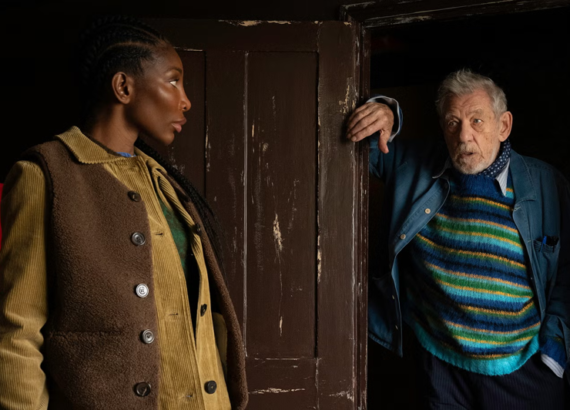




The Christophers
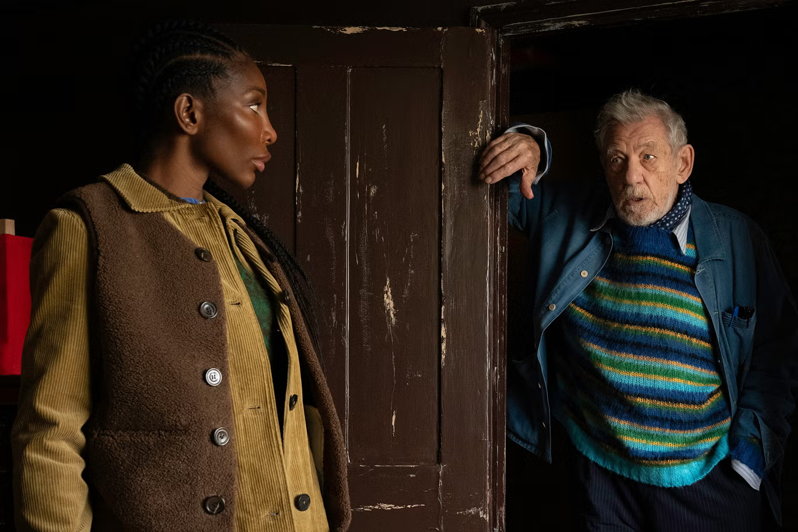
Film: The Christophers
Director: Steven Soderbergh
Release date: April 2026
Distributor: Neon (US) and Picturehouse Entertainment (UK)
Reviewed by: Rose Capp, PhD, MPCAC, BA (Hons), BSc, RN
The colorful lives of famous artists have provided plenty of inspiration for big-screen biopics, from mid-20th century depictions of Vincent van Gogh (Lust for Life, Minelli, 1956) and Michelangelo (The Agony and the Ecstasy, Reed, 1965) to more recent depictions of Jackson Pollock (Pollock, Harris, 2000) and J.M.W. Turner (Mr. Turner, Mike Leigh, 2014). Predictably, male artists have dominated the oeuvre with female artists garnering occasional attention, including films detailing the lives and work of Frida Kahlo and Margaret Keane.
Other explorations of artistic endeavor have been loosely inspired by prominent figures, the most recent of which is Steven Soderbergh’s (Soderbergh, 2026). Written by Ed Solomon, Julian Sklar (Ian McKellen) is the central figure in the film and clearly references David Hockney, among other prominent British artists of the period.
The fictional Sklar is an older man whose fame and output peaked in the 1970s. According to his critics, he was “once a paradigm of progressive politics but has now morphed into what is wrong with everything in the art world.” In more recent times he was “cancelled” for undisclosed misdemeanors, suffering the ultimate indignity of relevance deprivation. Julian lives in an impressive but chaotically cluttered 3-story house in Bloomsbury. In another nod to historical inspiration, the interiors were closely modeled on the studios of Lucian Freud and Francis Bacon. Once affluent, Julian is now reduced to recording paid personalized video messages to “pay the bills.”
His famous series of nine unfinished works, the Christophers of the film’s title, were portraits of his then lover and the means of a very public bisexual coming out. Describing them as “private matters–private affairs,” he has refused to talk about or complete the series in the decades since. But the paintings remain the subject of feverish media speculation and the basis for a ludicrous forgery plan by Julian’s semi-estranged children Sally (Jessica Gunning) and Barnaby (James Corden). In the opening scenes, Sally and Barnaby meet with Sally’s sometime art schoolmate Lori Butler (Michaela Coel) and propose that she apply to be Julian’s assistant and secretly complete the Christophers. They will then be “discovered” after his death and sold for a fortune. Lori is an artist and art scholar living a pretty threadbare existence running a food van. She has a “history” with Julian, and as Sally and Barnaby have calculated, a strong motive for revenge, so she agrees to take the questionable “job.”
The film is essentially a two-hander, with Lori and Julian sparring their way from hostility and suspicion to grudging creative and personal respect.
The lengthy exchanges between the two characters explore contrasting intergenerational and gendered ideas about artistic practice, academic writing, the vicissitudes of fame, and the role of the media, amongst many other topics. Solomon’s wickedly sharp script skewers everything from the pretensions of the art world to the thoughtless, conspicuous consumption of “tech bros.” What makes the developing relationship between Julian and Lori engrossing is the steady drip of small details and minor revelations that progressively suggests their similarities are more compelling than their differences.
Julian’s cryptic references to “cascading memories of wrongs done to me since childhood” are matched by unspecified challenges in Lori’s past and the abiding melancholy that defines her. Fiercely intelligent artists with self-destructive tendencies, both have been burnt by personal and professional betrayals.
McKellen is in vintage form as the vituperative Julian and is particularly scathing of his despised children, whom he variously—and hilariously—describes as buzzard Barnaby and hyena Sally and “the heirs abhorrent.” Thinly drawn characters bordering on caricature, their grasping attempts to cash in on their father’s legacy seem deserving of the vitriol he regularly directs at them. But Julian ultimately saves his harshest criticism for himself.
At the outset, he presents as a stereotypically cantankerous, unrepentant, and entitled older man. Holed up in self-imposed isolation in his creative man cave, Julian is still raging at a world that has comprehensively rejected him. But as the film unfolds and he becomes increasingly intrigued by Lori, honesty and self-criticism kick in. At one point, Julian casts Lori as the “Jane Goodall to the old dancing monkey,” questioning out loud if she will tell her friends about the “old fool.” He acknowledges that “art and talent departed my life a long time ago” and later, that “I’m a broken man, I believe I always have been…all the lies I’ve been telling myself my whole life.”
He admits, “I’ve spent years googling myself,” and quotes Lori’s detailed and excoriating analysis of his work back at her. Her article asks a fundamental question about artistic practice and legacy that Julian himself is clearly struggling with: “Will his work even last?” As he remarks, “That’s the thing, isn’t it? To last in the minds of others.” Soderbergh himself may have pondered something similar when he famously told The Guardian in 2013 that he was retiring from feature filmmaking because “movies don’t matter anymore.” (Child, 2013).
Many cinematic portraits of artists focus on a particular period, work, or muse, but in challenging an older artist at the end of his life with a younger counterpart very much his intellectual and creative equal, the script mines rich reflective terrain. It is a strength of Solomon’s writing, Soderbergh’s direction, and two forceful central performances that a story focused on two unlikeable characters gradually transforms into a moving examination of creative and emotional vulnerabilities.
References
Child B. (2013). “Stephen Soderbergh retires from film: ‘Movies don’t matter anymore’”. The Guardian, https://www.theguardian.com/film/2013/jan/30/steven-soderbergh-retires-from-film
Harris E. (2000). (Director) Pollock. [Motion picture] US. Sony Pictures Classics.
Leigh M. (2014). (Director). Mr Turner United Kingdom, France and Germany. Entertainment One, Diaphana Films, Prokino Filmverleih and 20th Century Fox.
Minelli V. (1956). (Director) Lust for Life. [Motion picture] US. Metro-Goldwyn-Mayer.
Reed C. (1965). (Director) The Agony and the Ecstasy. [Motion picture] US. 20th Century Fox.
Soderbergh S. (2026). (Director) The Christophers. [Motion picture]. Neon (US) and Picturehouse Entertainment (UK).
Oxford University Press/The Gerontological Society of America. Reproduced with permission of the author. Originally published in The Gerontologist, Volume 66, Issue 9, September 2026, https://doi.org/10.1093/geront/gnag152.