

Riot Women
TV Series: Riot Women
Director: Sally Wainwright and Amanda Brotchie
Release date: October 22, 2025
Distributor: (In North America) BritBox
Reviewed by: Jim VandenBosch, MA and Rose Capp, PhD, MPCAC, BA (Hons), BSc, RN
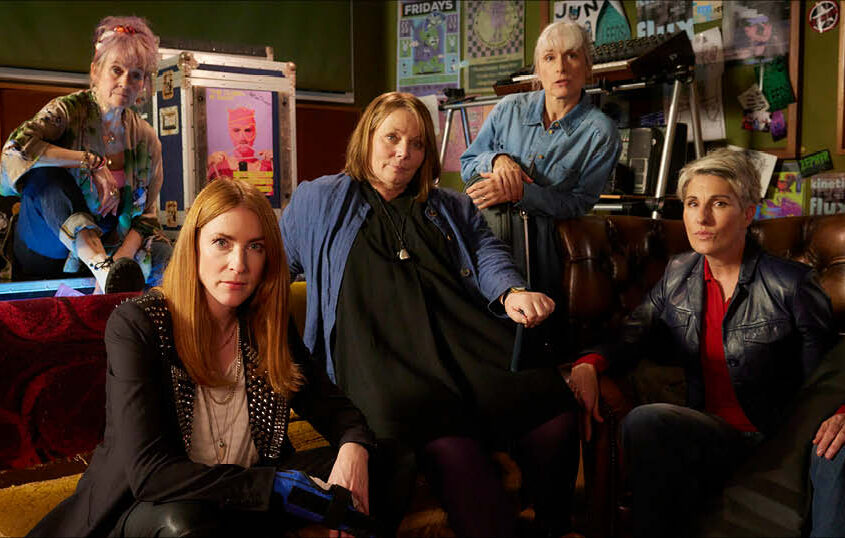
Image: BBC / Drama Republic
Jim Vanden Bosch: A few years ago, we (Rose and Jim) did a joint review of a film that portrayed the lives of four older women as they faced the experience of growing older.1 The film was Book Club (Holderman, 2018). I (Jim) felt a bit out of place reviewing it as a guy, so I asked Rose to review it with me. Well, here we go again. Riot Women (Wainwright & Brotchie, 2025) is a compelling six-part television series about a group of middle-aged women who come together to form a fledgling punk rock band. The series is written primarily from a woman’s point of view and covers multiple issues central to being a woman at mid-life. But the series also addresses issues that apply to both genders—child sexual abuse, same sex relationships, the “sandwich” generation and elder care, domestic violence, racism, multi-generational households and workplace harassment. So, Rose and I decided to write another joint review.
The TV series, set in a small town in West Yorkshire, England, opens on a dramatic note. A woman stands nervously on a stool and begins to place the noose of a blue nylon rope around her neck. She hesitates and adjusts the noose. Then, just as she is placing the noose over her face, her landline phone rings. She takes the noose off and goes to answer the phone. It is her brother. In the short conversation that follows, we learn that he is extremely unhappy with her unilateral decision to use their mother’s money to pay for her to be placed in an upscale care home. “That’s 240,000 pounds that could have been our inheritance—eventually. This should have been discussed.” The woman replies, “I did discuss it, with her solicitor. …this is how the cookie crumbles when you don’t visit your own mother for six years!”
After this heated conversation, the woman returns to the stool and the noose. With a mixture of fear and agitated determination, she places the noose over her head and adjusts her feet on the stool. Then her cell phone vibrates on a nearby table. This time it is a good friend; she asks her if she would like to be in a rock band as part of a fundraising event she is putting together for refugees. “Please say yes. I could do with a bit of a laugh, and I know you could.”
The introduction to the other main character in this series is equally dramatic. An inebriated woman weaves through the aisles of a grocery store, bumping into other customers before grabbing three kitchen knives from a shelf. She then moves to the drug and the liquor aisles. She grabs a bottle of vodka, uncaps it, rips open a package of pills and swallows them with several glugs of vodka. Two female police officers arrive and try to talk her down, but this turns into an explosive scuffle resulting in her arrest.
These two scenes vividly set the tone for a series of intense stories that slowly reveal the personal issues facing each of the women who ultimately become part of the fledgling punk rock band, Riot Women. Some of the issues remain in the background for a time, only to move to center-stage as the stories shift and unfold.
Rose Capp: Firstly, I have to thank you, Jim, for drawing my attention to the brilliant Riot Women! I have had numerous discussions with family members, friends and colleagues about creator/writer/co-director Sally Wainwright’s series.2 These conversations have predominantly been with middle-aged women, the clear target audience for Riot Women. The response is an immediate and almost visceral embrace of the characters and the series, and a passionate identification with the issues Wainwright explores. Many women single out Joanna Scanlan’s performance as Beth, the character who is in equal parts the lightning rod and lynchpin of the group and the series. A hardworking teacher, Beth is demoralized by her job, the recent departure of her husband and her son’s benign neglect. “They’ve all had the best of me for years and now I’ve nothing left to give, I’m dispensable.”
Beth gives the band their name and articulates their raison d’etre. “We sing songs about being middle-aged and menopausal and more or less invisible—and you thought the Clash were angry!” Arguing against performing an anodyne version of Abba’s Waterloo, Beth declares the band’s songs should be documenting “… people like us in mid-life crisis, parents, children still doing your head in, the menopause. And then in the middle of all that, you become invisible, even to yourself—just when you thought you had traction in the world.”
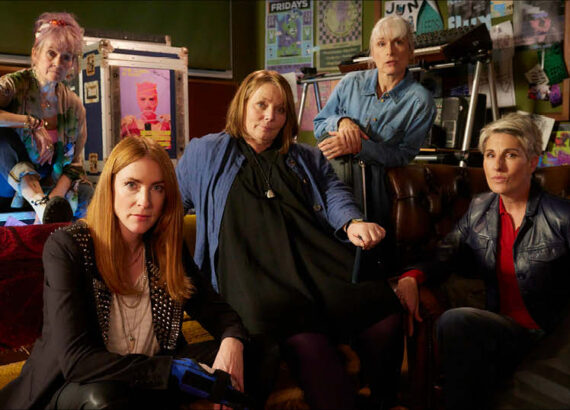
Riot Women is an ensemble piece focusing on the five central characters and band members, Beth, singer Kitty (Rosalie Craig) pub owner Jess (Lorraine Ashbourne), newly retired police officer Holly (Tamsin Greig) and midwife Yvonne (Amelia Bullmore), with an array of well-drawn and significant supporting characters. The five women are, in different ways, profoundly frustrated with the individual and systemic challenges they face in their personal and professional lives. Wainwright’s script does not hold back, with the women calling out everything from opportunistic sexual harassment to the often-debilitating physical realities of menopause. But the women are also funny, foul-mouthed, anarchic, brutally honest and warm-hearted characters who care deeply about each other, their families and communities.
It is this potent combination—and the way Kitty’s gutsy vocals literally give voice to their collective frustrations in the songs she and Beth write together—that makes the series so compulsively watchable. And while the women’s situations and songs speak directly to the shared experiences of middle-aged women the world over, they also appeal to a broader audience. As a male reviewer noted, “I was emotionally invested in the women and their lives and could relate, even as a middle-aged man, to the angst, and loss of self-worth, and the pigeonholing that the world projects onto huge swathes of society.” Younger women commented that they could identify with the anger and frustration because as one noted, “boys at my school behave like that.”3
J.V.B.: When I discovered Riot Women, and read the brief description of the series, I was not sure I would find it that watchable. It sounded like it was geared for a female audience. My wife and I routinely watch a couple hours of TV programming together in the evening. Since our tastes in viewing can be quite divergent, we have an agreement that either of us can veto a program or film if we do not like it. I was prepared to use my veto on Riot Women. But from the earliest scenes, the show grabbed me and did not let go. No veto for this show.
Men, in general, do not come across well in this series. From overt and brutal abuse, to simply being negligent and insensitive, their behavior, past and present, is often a catalyst for the women’s frustrations and their songwriting. This does not mean that Riot Women cannot be a gripping watch for men. Men may not be able to feel some of the issues reflected in this series as personally as a woman, but they can be equally appalled by how some men treat women.
R.C.: I think the music is fundamental to the appeal of the series. The band’s embrace of the punk genre is a perfect match with their unabashed rebelliousness. Rosalie Craig’s electric performance as the deeply troubled Kitty brings a raw power to the band’s performances. Having escaped her dysfunctional, criminal family but lived on the edge ever since, Kitty is angry, impulsive and often hard to identify with, but she belts out the deeply personal songs with utter conviction.
The songs are original and written by ARXX, a Brighton-based, two-woman alternative rock outfit. Following a steep learning curve (replicated in real life as the actors had to learn to play their instruments and do so convincingly), the band’s increasing confidence and embrace of uncompromising lyrics is as liberating for the audience as it is for the characters. The band’s performance of two full-length songs, “I See Red” (Give Me HRT!) and “You’re Just Like Your Mother” is simply exhilarating.
The latter song is emblematic of the group’s shared sentiments and the series’ key theme of reasserting mature female agency. Wainwright drew on her ex-husband’s snide response during arguments, a passive-aggressive rejoinder many women would recognize. Beth flips the script, observing “I used to regard it as an insult until mum got dementia and I remembered how wonderful she had been…brilliant, kind and articulate and yes, ‘I am just like my mother thank you very much!’”
J.V.B.: Besides its gripping content, the other reason I find this series so watchable is that it is brilliantly made. Everything about it—the dynamic pacing, the lighting, the rich color, the acting, and the music all work together to create a series that I could not help but get immersed in watching. In one pivotal scene, for example, Kitty reveals something to Beth that could potentially change their newly bonded relationship. The acting in this scene between the two women is astounding. The pacing of their dialogue and their facial expressions create an edge-of-the-seat moment for viewers. In fact, it’s an edge-of-the-seat several moments because the scene goes on for a full six minutes, even though it feels like it only lasts a moment or two. It is so full of emotion that viewers are likely to be brought to tears watching it.
The other thing that enhances the pleasure of watching this series is the effortless way that it seamlessly weaves together intense drama with delightful humor. For a program that deals with so many heavy and often painful issues this is a rare feat. The humor never feels jarring. On the contrary, it is contextualized in a way that provides welcome relief from the intensity of the drama. For example, as the scene I just described above closes out with a graceful and welcome resolution to the drama inherent in it, we are immediately taken into a scene from the love life of one of the other characters. The scene is filled with inherent humor and provides an immediate light-hearted release from the heavy emotion of the previous scene.
Another standout characteristic of this series is the frequent change-up in the pacing. There are times that a scene, particularly the more light-hearted scenes, move so quickly that one can barely keep up with the dialogue. These are interspersed with scenes that are more slowly paced and that allow the drama inherent in them to seep into the viewer’s consciousness.
R.C.: Wainwright’s gynocentric focus is expansive across the life course, tackling multi-generational households, same sex relationships, step-parenting and cognitive decline. Elder care is one of the more understated, but significant subjects the series explores. I was particularly interested in the way in which Wainwright addresses the challenges and complexities of dementia care, for both the women providing care, and the women living with dementia in older age.
The increasing prevalence of dementia is an urgent global public health issue, and studies consistently show that “women provide around 70% of all informal dementia care, highlighting another way in which the disease disproportionately impacts the lives of women.”4 This is the reality for many women and Wainwright explores the issues thoughtfully through three different scenarios involving older women living with varying degrees of cognitive impairment and dementia.
Beth’s mother lives with advanced dementia and as the opening scene makes clear, Beth has ensured she receives the best possible support. The decision to admit her to a care home still weighs heavily on Beth, a deeply confronting and often distressing experience that many viewers would identify with. Beth’s visits to her mother are loving but silent vigils. Sisters Holly and Yvonne are reluctantly contemplating a similar move. Their mother Nancy (brilliantly played by Anne Reid) lives alone but is struggling; rude and combative to her paid carer, Nancy experiences confusion and paranoia and relies increasingly on Holly for support.
In a beautifully scripted scene, Wainwright explores how to support a person with dementia when they have returned to the distant past and are speaking of long dead family members in the present tense. Holly’s intuitive responses to her mother’s time shifting show insight and empathy. What Wainwright also makes clear is that despite her cognitive challenges, Nancy’s strong personality and sharp sense of humor are intact, and she continues to participate in family life, including attending the inaugural Riot Women performance.
Jess’s Aunty Mary (Sue Johnston) lives in the chaotic, multigenerational Burchill household with Jess’s daughters Miranda and Chloe, and Chloe’s three young children. A dreadlocked, dope-smoking, first wave feminist, Mary is clearly living with some degree of cognitive impairment and resents references to the need to supervise her. But Mary is an integral part of the family and continues to live a good life, picking up on family dynamics and issues that Jess is sometimes too busy to notice, and playing a meaningful role as the family elder.
J.V.B.: After watching Riot Women, I found myself thinking about the review we did of Book Club, and how that film compares to this series. I think you referred to Book Club as an example of a “geronto-com.” We also had a fairly vibrant conversation in that review about the use of humor and how it can sometimes reinforce ageist stereotypes. It strikes me that Riot Women, even though it is frequently humorous, never falls into this trap. Now that I think about it, that is another amazing strength of this series—it never stereotypes aging. All the characters and storylines deal with aging-related issues in a nuanced and realistic way.
R.C.: I recall we had some interesting differences in our reading of Book Club Jim, but we are in furious agreement on Riot Women! Where Book Club was limited by its two-hour running time and genre constraints, Wainwright had six hours to investigate the complexities of her five lead characters and their equally complex situations. The humor is frequently dark but self-deprecating, often directed at the foibles of both men and women, and always serving to explore rather than exploit the experiences of older women.
Riot Women shines a welcome spotlight on five, as Beth describes them, “women of a certain age” who have felt or feel “invisible.” The series speaks to a broad audience but predominantly middle aged and older women who have worked hard, raised children, and been supportive partners, parents, and carers for their own parents. Wainwright’s script makes sure the women are not only seen but equally importantly heard. The band’s performances are an unfiltered musical expression, in equal parts unadulterated rage and joy. Riot Women ended with an unmistakable cliffhanger, signaling a second series, which is currently in production. It goes without saying that we are both keenly waiting to see where the next season takes the Riot Women!
Footnotes
- Jim VandenBosch, Rose Capp, Reading Between the Lines: Two Takes on Book Club, The Gerontologist, Volume 59, Issue 1, February 2019, Pages 186–189, https://doi.org/10.1093/geront/gny156
- Australian director Amanda Brotchie directed episodes 4, 5 and 6.
- International Movie Database. User reviews: https://www.imdb.com/title/tt32315888/reviews/?ref_=tt_ov_ql_2
- The Lancet Public Health. Reinvigorating the public health response to dementia. Lancet Public Health. 2021 Oct;6(10): e696. doi: 10.1016/S2468-2667(21)00215-2. PMID: 34563278; PMCID: PMC8516159.
Oxford University Press/The Gerontological Society of America. Reproduced with permission of the author. Originally published in The Gerontologist, Volume 66, Issue 11, November 2026, gnag215, https://doi.org/10.1093/geront/gnag215