


A Man on the Inside

Television Series: A Man on the Inside (eight episodes; 27-34 minutes each)
Created by: Michael Schur
Released: 2024
Available on Netflix
Creating a documentary that accurately reflects day-to-day life in a residential care facility is nearly impossible. Most eldercare residences have strict policies that prohibit any video recording within the building.
In 2019, Chilean filmmaker Maete Alberdi did manage to bring a film crew into an eldercare residence. She told the staff and residents that her filming was to be part of a general study about eldercare. Because the privacy regulations are not as strict in Chile as they are in the United States and many other countries, the nursing home administrator allowed Alberdi’s crew to film inside the facility. In reality, Alberdi’s purpose for filming was to document an undercover mission of a private detective agency hired to investigate the possible theft of jewelry from one of the residents. The resulting film, The Mole Agent (Alberdi, 2020), became one of the most intriguing films ever to be shot totally inside a residential care facility. I reviewed the film in an earlier issue of this journal (VandenBosch, 2021).
That groundbreaking documentary has now become the source of a new TV series on Netflix. The series, A Man on the Inside, incorporates the same basic story that played out in the documentary, and for the most part, it follows that storyline quite faithfully. Both the tone and the setting of the series, however, differ sharply from the documentary. The documentary starts off with a humorous tone that makes it seem as if viewers will be watching a tongue-in-cheek spy caper carried out by an older man who may not be capable of pulling it off. But the film soon morphs into a serious look at how this older man sees and responds to the sense of loneliness and isolation that affects many of the residents. The documentary was filmed in a modest nursing home in the Santiago Metropolitan Region of Chile. Because the facility housed some individuals who were experiencing dementia, it was a locked residence. Residents rarely ventured out of the building.
By contrast, A Man on the Inside is set in the Nob Hill area of San Francisco, one of the highest-income neighborhoods in the United States. (By giving the series a San Francisco setting, the creators gave a nod to the original documentary where the name of the residential care facility is the San Francisco Nursing Home.) The residence is presented in the series as an upscale retirement community rather than a nursing home. Except for a separate area secured with code-locked doors for persons living with dementia, the residents can come and go as they please.
In the series, the retirement home appears to be small enough that the residents and staff all know each other (and each other’s business). No interloper could stay for long in the building without being noticed. This brings us to the core of the story that plays out in the eight-episode series. When a well-to-do son hires a private investigator to find out who stole a prized heirloom necklace from his mother in the retirement home, the investigator realizes that the only way she can gain access to the facility is to hire an older person to move in as a resident and from there conduct an undercover probe.
After interviewing several prospective candidates for the position and finding a woeful (and stereotypical) lack of competence with cell phone technology, she settles on an older gentleman, Charles Nieuwendyk (Ted Danson); he can clearly navigate all the functions on his cell phone, and he appears to be confident and knowledgeable. He is retired and, at the urging of his daughter, is looking for something meaningful to do after the recent death of his wife.
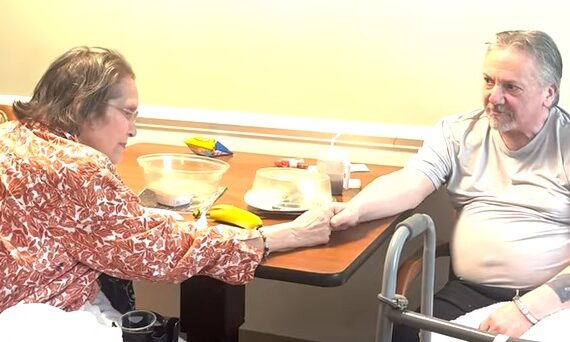
The series quickly develops into a winsome blend of humor and poignancy as Charles takes on the role of undercover investigator (Figure 1). Several additional characters—the director of the retirement home, residents and staff in the home, and Charles’ daughter–fill out the story.
For the most part, the series has strong scripting and acting, and moves along at a brisk pace. It has a vibrant music track. Numerous songs from a variety of genres—from rock to soul to jazz–play throughout each episode and usually reflect the theme of what’s going on in a particular scene.
In episode after episode, the scenes play out with sparkling humor that is interspersed with empathy and emotional depth. Within its overall comedic tone, the series reaches for and finds areas of vulnerability and human connection as Charles moves beyond sleuthing and into friendship with many of the residents.
While the series is genuinely funny, with several moments of laugh-out-loud comedy, there are times when the humor walks a fine line between “laughing at” and “laughing with.” Comedy can be tricky when it deals with aging. Are you in on the joke, or are you outside of the joke? Are you laughing with or laughing at? I can laugh at my own aging self, but if someone else laughs at me, it can feel hurtful. When my older friends and I get together for breakfast, we can laugh heartily together at the foibles of our aging selves; we are laughing with. But if someone outside our group were to level a joke at one of us that made fun of one of our aging foibles, we would feel the wrongness of it.
Most of the “laughing at” humor in A Man on the Inside happens during the little side story scenes involving some of the residents—stories that accompany the main plot and help fill out the length for an eight-part series. In those scenes, it feels like the script and dialogue were written by someone still ensconced in the dominant cultural/societal perception of older adults as slightly inept and “cute.” Some of this “laughing at” tone comes in the form of sexual inuendo, particularly involving one of the older female characters, Virginia (Sally Struthers), who openly fawns over Charles as soon as he arrives in the residence. In one comment, for example, addressed suggestively to Charles, she says “I don’t do yoga; I’m naturally flexible.”
Another example of insensitive humor happens when we are shown a scene from a residents’ council meeting. The scene is rife with the stereotyped foibles and one-liners of a self-aggrandizing council president and several feeble-minded residents. The dialogue is weak and inauthentic. It is an over-the-top attempt to squeeze humor out of the scene.
Often this kind of humor in a TV series or a movie can feel harmless; it flies under the radar. One way to test it is to substitute any other marginalized group for the older adults in these scenes and see how it would feel to get the same humor from it.
By the end of the series, Charles has figured out who stole the necklace. In the last episode we see him dealing with the consequences of the deception that he and the detective agency used to uncover the theft. He had gained the affection and trust of many of the residents and staff. Now he must tell them the real purpose of his stay. Most of them feel offended and betrayed. But all is resolved and forgiven by the end of the episode, and the last scene leaves the door wide open for a second season.
A Man on the Inside deals entertainingly with several elderhood and aging-related issues. Viewers will need to keep in mind that its posh setting does not reflect all retirement homes. Viewers will also need to have their agism and stereotyping sensors in play as they watch some of the scenes, but on balance, the series is a welcome addition to a growing number of TV programs that sensitively reflect the lives of older adults.
– Jim Vanden Bosch
Oxford University Press / The Gerontological Society of America. Reproduced with permission of the author. Originally published in The Gerontologist, Volume 65, Issue 6, June 2025, gnaf098, https://doi.org/10.1093/geront/gnaf098