


POST #10
On the Road to Older Age: Insights from the ‘Elder Odyssey’

The ‘road movie’ is a venerable narrative tradition that has been identified with the history of American cinema in the second half of the twentieth century. Big screen characters frequently went ‘on the road’ to escape financial and emotional hardship or the forces of law and order. In the classic road movie scenario, issues of personal identity are explored along with the wider world, and the geographical distance travelled was often a symbolic measure of the extent of a character’s emotional or psychological transformation.
An intriguing contemporary sub-genre of the road movie has been dubbed the ‘Elder Odyssey.’ These films typically feature one or more older characters taking to the road to seek knowledge, redemption or reconciliation, often with estranged or long-lost family members, friends or lovers (Shary and McVittie, 2016).
The standard vehicle of choice in the road movie is the car, but the idea of the ‘road’ and the associated journey has been variously interpreted. This has included everything from pedestrian pilgrimages (The Way [2010], The Unlikely Pilgrimage of Harold Fry (McDonald, 2023), The Way, My Way (Bennett, 2024) and The Salt Path (Elliott, 2024) to ride-on mowers (The Straight Story, Lynch, 1999) and two-seater mobility scooters (Thelma, Margolin, 2024).
The genre has historically been dominated by male characters – contemporary examples include About Schmidt (Payne, 2002), Nebraska (Payne, 2013), The Great Escaper (Parker, 2023) and The Unlikely Pilgrimage of Harold Fry (McDonald, 2023). In recent decades, older women have also taken to the road in Cloudburst (Fitzgerald, 2011), Nomadland (Zhao, 2020) The Fabulous Four (Moorhouse, 2024) and Thelma (Margolin, 2024).
As older characters and issues around aging are explored more regularly on the mainstream screen, the diverse group of films that comprise the ‘elder odyssey’ have contributed valuable perspectives on the lived experience of older age. Unsurprisingly, some of these films explore illness, frailty and imminent mortality. Intriguingly, many of these are classified as comedies or comedy-dramas (The Straight Story, Nebraska, The Leisure Seekers, [Verzi, 2017], Last Cab to Darwin, and The Great Escaper). While ill health is acknowledged in these scenarios and is often the catalyst for the journey, it is not the defining feature of the story.
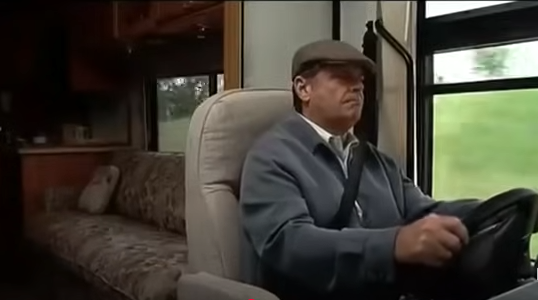
What does define the contemporary elder odyssey is the way in which older characters are depicted as active, engaged and above all, having agency. The central protagonists in these films often tackle diverse personal challenges and contribute energetically and meaningfully to the lives of others. This signals a modest but significant shift from what was described only a decade ago as the persistently stereotypical depiction of older characters on screen. ‘Grannies in cardigans and men shuffling about their gardens remain dominant depictions …’ (Whelehan and Gwynne, 2014).
In The Great Escaper, WW2 veteran Bernie (Michael Caine) ‘breaks out’ of his care home to attend D-Day commemorations in France. He successfully navigates the channel crossing and along the way, restores the wellbeing of his fellow veterans on either side of the conflict. Similarly, the kindly but reticent Alvin Straight (Richard Farnsworth) is a supportive presence to a runaway teenage girl and fellow war veteran. These are just a few of many people he meets on his epic, 400km ride-on mower trip to visit his ailing brother. In the Australian film Last Cab to Darwin, terminally ill cab driver Rex (Michael Caton) drives 3000 km in his taxi to access assisted dying measures in Darwin. During the long drive, Rex befriends and assists an unsettled young indigenous man and an English backpacker. All three films feature an older protagonist who not only takes forceful action to change the circumstances in his own life, but effects change in the lives of others. Coincidentally, all three films were based on or inspired by true stories.
Chloe Zhao’s Nomadland is memorable for many reasons, most conspicuously for its authentic depiction of older adult homelessness. A relatively rare topic in the elder odyssey sub-genre (The Salt Path is another recent example), Chloé Zhao’s award-winning film focuses on Fern (Frances McDormand). Recently widowed and made unemployed, Fern sells her Nevadan house, buys a van and takes to the road. Hard scrabble seasonal jobs take Fern all over the country and keep her in food and petrol. Along the way, she meets a diverse group of people, befriending some, and assisting and accepting help from others.
As with many of her fellow nomads, Fern’s changed circumstances are potentially disempowering but her decision to go (and stay) on the road depicts her as a determined older woman, taking decisive action and making tough choices. As Fern describes it, she is ‘not homeless but houseless; not the same thing, right?’
Dan Hillman’s observation that it is the ‘journey not the destination’ is a thoroughly overworked cliché in the global vernacular. However, in the context of the elder odyssey, the literal and emotional journey these older characters undertake is frequently a transformative one. In many of these films, there are no easy choices or neat dramatic resolutions. Rather, the emphasis is on older characters being independent, open to new experiences and actively involved and interested in the lives of others.
– Rose Capp